
With retakes and high stakes, perfect grades are the expectation
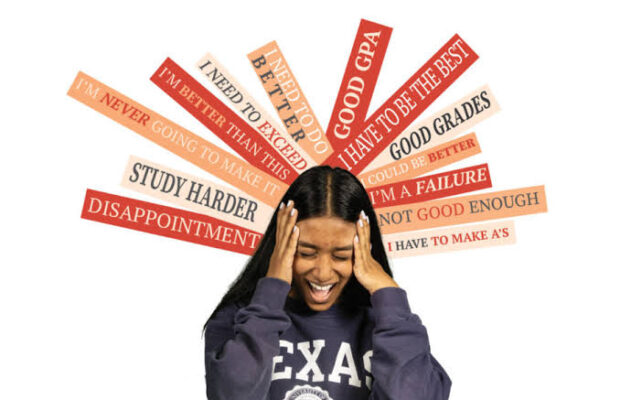
High school. Walk down any high school hallway right before final grades post, and you will hear a familiar, anxious whisper “What did you get?”
For decades getting a straight A report card was viewed as a goal for the top of the class. Today for a big number of teenagers, an A is no longer seen as an achievement; it has become the minimum expectation. Driven by high stakes college admissions, parents pressure and their own thoughts, students are pushing themselves to the edge to maintain a perfect academic record.
For freshman Grace Goodwin, the pressure hits especially close to home. Despite being in her very first year of high school, a transition period that usually involves trial and error, Goodwin maintains straight A’s, but keeping up that record comes at a steep cost.
“I feel like the expectation is always to have things that others don’t, or to constantly try to outdo yourself,” Goodwin said. “Even when I’m doing well, I feel like I’m not as good as I can be, so I just try harder and harder.”
Goodwin’s internal mindset is increased by strong pressure from home. Her parents maintain a strict academic policy.For Goodwin, this creates a relentless mindset where a B feels like a failure, and standard learning curves are treated as costly mistakes.
The debate over academic expectations recently intensified with the district’s introduction of a new retake policy. Designed by administrators to focus on true subject mastery rather than high stakes test taking, the policy allows students to retake major assessments if they fall short on their first attempts.
For many educators, the policy is a welcome relief meant to encourage growth and lower student anxiety. However, for students like Goodwin, institutional support doesn’t always translate to relief at home.
She said that her parents do not believe in taking the advantage of retakes. In their view, a student should demonstrate complete perfection and give maximum effort the first time around making second chances off limits.
For older students, the pressure to be perfect doesn’t just disappear when high school ends; it evolves. My sister Ace is a sophomore studying business, and she remembers feeling the shift the moment she stepped onto her college campus. After graduating near the top of her high school class, she realized everyone around her was used to being the smartest person in the room.
“In high school, getting straight A’s was second nature if you just did the work,” Ace said. “In college, the curve is harsher, and the standard is way higher. I started feeling like if I wasn’t excelling immediately, I was already falling behind my peers.”
Instead of falling back to her expectations, Ace doubled down. She describes spending late nights in the library, trading social events for extra study sessions and re-reading textbooks to make sure she didn’t miss a single detail.
“It becomes an obsession with control,” she said. “College gives you so much freedom, but when everything else feels uncertain, your grades become the one measurable metric of your success. If my grades are perfect I feel like I’m in control.”
You may also like...



-

Fall esports teams readying to finish seasons strong
The fall esports season will come to an end next week, and teams are trying to cement their place’s in the upcoming playoffs. Numerous teams are on the verge...


You must be logged in to post a comment Login