
Students call for revisiting recent restrictions on music during class
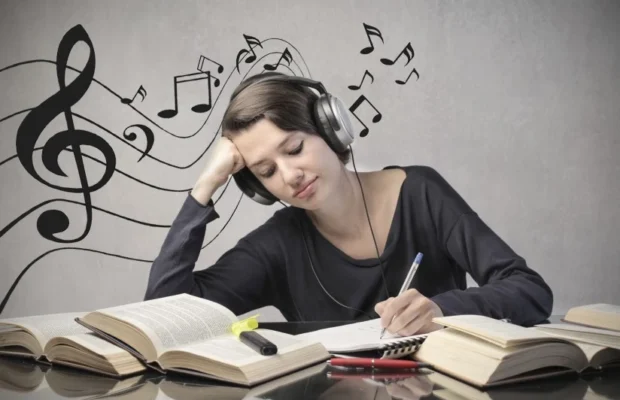
For many students, staring at a blank screen in a noisy classroom is going to turn into an instant burnout. Without background music to block out surrounding conversations, study time can quickly transform into a battle against distraction and exhaustion.
With recent school-wide headphone restrictions, students across grade levels are voicing concerns over how the policy impacts their ability to cope with classroom anxiety, maintain focus and complete daily workloads.
“When a teacher gives us work in class, it’s unadulterated dread knowing that I will be staring at a screen or a paper, bored and tired,” sophomore Nathan Keve said. “Music energizes me enough to do work and stay focused.”
Keve isn’t alone. Other students also shared how music functions not as a distraction, but as an essential tool for navigating throughout the academic day.
A primary issue students face during independent work time is the classroom environment. Conversations, movement, and hallway noise can easily break concentration, making quiet study periods feel pointless.
“It drowns out other distractions, like if someone is talking and you need to focus,” junior Haliey McCormick said. “It helps to listen to music without being interrupted by laughing or screaming.”
Beyond noise cancellation, several students noted that auditory stimulation helps regulate stress levels.
“I get anxiety a lot from noises as well, so it helps me calm down,” McCormick added, noting that upbeat music keeps her awake when physical fatigue sets in at the end of the day.
Senior Stella Ufford, who frequently relies on music while studying, echoed the view that headphones serve a functional, sensory purpose rather than an act of tuning out instruction.
“Some students need headphones or music in order to not get overwhelmed by loud noises and school work,” Ufford said. “Some teachers think this an excuse of sorts, which is almost never the case.”
While administrators often enforce headphone bans to encourage peer interaction and teacher engagement, students argue that complete silence during independent work often backfires.
Without having music or something to listen to, boredom then sets in, leading students to create their own distractions.
“Without people being able to listen to music in class, they will talk to entertain themselves,” Keve said. “And when some talk, all talk. Kids don’t learn if they are bored. Kids don’t learn if they dread the work.”
For many, pairing music with repetitive or long assignments turns an intimidating task into a more manageable one. Keve noted how much faster he advanced on writing assignments when allowed to listen to his favorite tracks or podcasts.
“When I am 186 words into a 500-word essay, and I’m hearing my music, I will easily breeze through it with joy. Instead of me associating the work with boredom and annoyance, I will associate it with things I love.”
Despite their frustrations with headphone bans, many students were not asking for unlimited or unmonitored phone access during instructional time. Instead, most expressed support for more sensible compromises that balance administrative goals with student focus needs.
Proposed solutions included Chromebook-only streaming, which allows students to stream music via school issued devices (such as Spotify on Chromebooks) while still requiring cell phones to stay hidden in backpacks.
Another suggestion is work-time only with permission, restricting headphones use strictly to quiet, independent work time at the teachers permission, while keeping them off during direct instructions.
Lastly, some suggested one earbud policies: permitting a single earbud so students remain aware of their surroundings and safety instructions.
“I am fine with being able to listen to music during independent work time only,” Keve said, emphasizing that students listening to music isn’t appropriate while the teacher is actively teaching. “As long as we are allowed to and teachers won’t just say no every time.”
Ufford agreed that maintaining clear boundaries around phone use is fair, provided the ability to listen to music isn’t eliminated entirely. “Having students able to have access to that ability in order to work better or maintain more focus would help,” she said.
As schools continue to work on policies about technology in the classroom, students said they hope that administrators will view headphone use through a more nuanced lens—one that recognizes music as a valuable partner in learning rather than an obstacle to it.
You may also like...


-
Students call for revisiting recent restrictions on music during class
For many students, staring at a blank screen in a noisy classroom is going to turn into an instant burnout. Without background music to block out surrounding conversations, study...


You must be logged in to post a comment Login